Exact transport
The Six Tongues execute reversible byte mappings. The strongest current claim is transport, typed routing, and consistency checking—not encryption.
Architecture edition / receipt-backed build
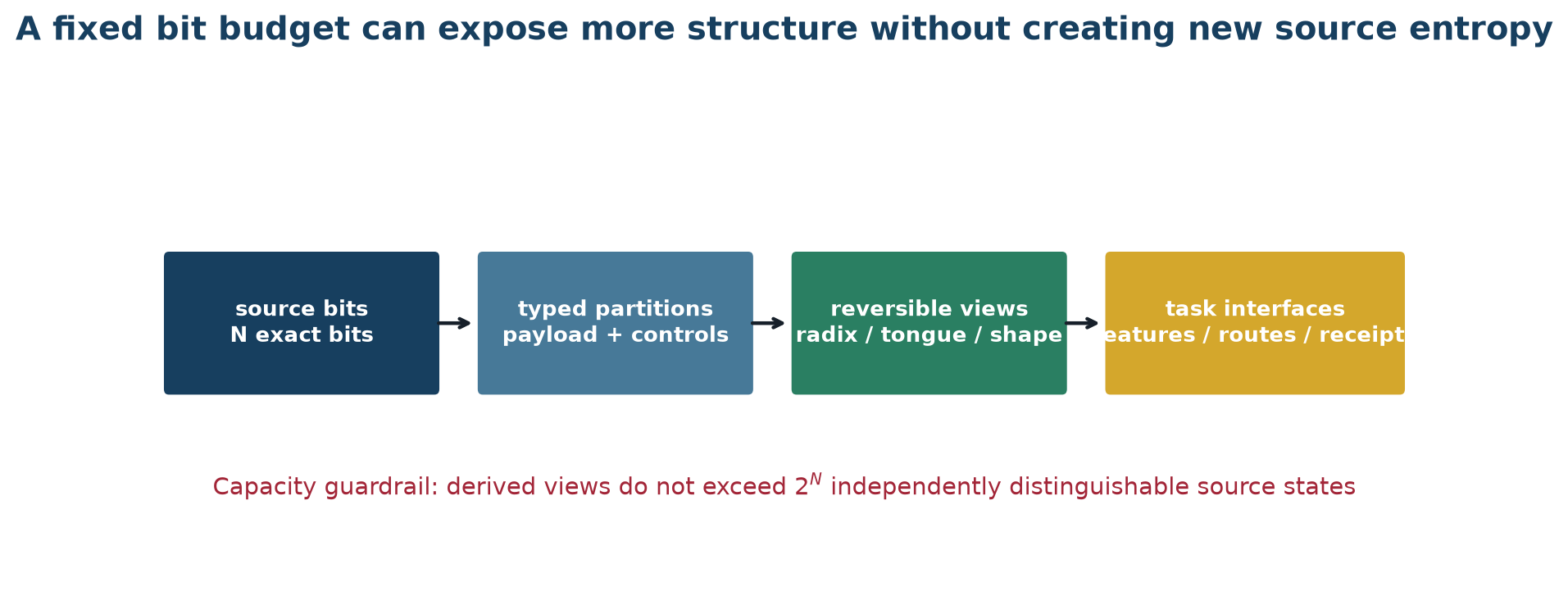
One exact object can have many useful views without becoming more information than it was.
Binary, balanced ternary, negabinary, a tongue token, and a geometric coordinate can expose different structure while still pointing back to the same byte.
“A glyph is an address, not a proof.”
The book keeps the source identity underneath every abstraction. A new view may make a route easier to see; deterministic re-encoding does not create new independent entropy.
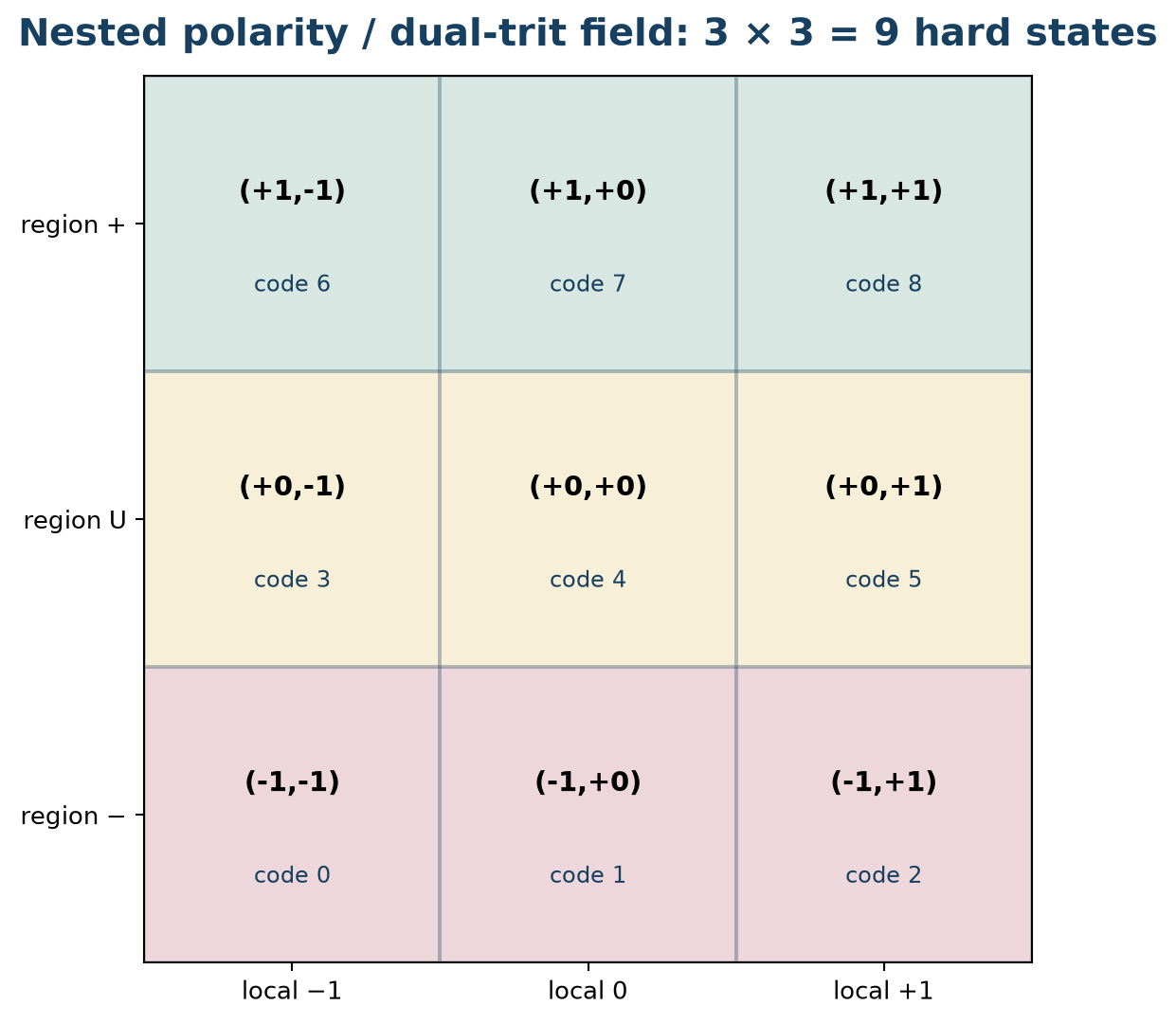
The interaction rule determines the state space. Pair one sign bit with one magnitude trit and you get six states. Give two trits independent jobs and you get nine.
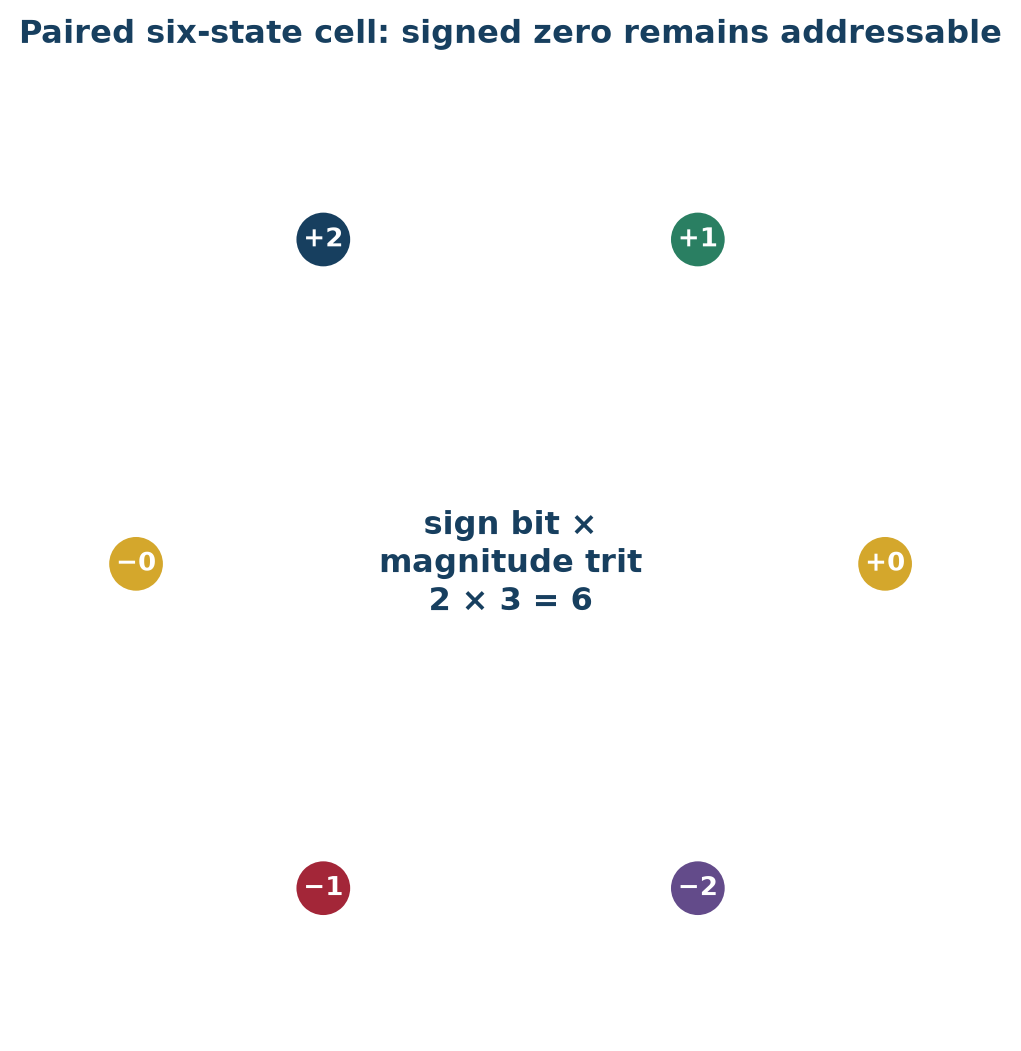
2 × 3 = 6
A sign bit selects positive or negative. A magnitude trit selects zero, one, or two. Signed zero remains addressable.
Use this when the two fields have different jobs and the allowed combinations are exactly six.
A calm, systems-first audio guide to the book’s central constraint. Generated from a fact-checked script, normalized for listening, and paired with the full transcript.
No autoplay. Your place stays yours.
Continue into the new radix-lattice research branch →How many ways can one byte tell the truth?
Binary. Negabinary. Balanced ternary. Six symbolic languages. A color. A tone. A coordinate in curved space.
Each view can reveal something different. But none of them is allowed to forget where it came from.
Start with the physical carrier. Eight bits give one byte exactly two hundred and fifty-six possible identities. Rewriting that byte in another radix may expose sign, symmetry, phase, adjacency, or a convenient route. The representation changes. The source identity does not.
That is the central constraint in Trits, Bits, and Bobs: one exact object, many operational views, and one route home.
The saved shared-byte audit contains two hundred and fifty-six synchronized bundles. Its coordinate charts and tongue mappings round-trip to the original byte. That is measured evidence for identity and reversible transport. It is not evidence that the views create additional information.
Now count the state honestly.
A paired six-state cell combines one binary sign axis with one three-level magnitude axis. Two times three gives six addresses: negative and positive zero, one, and two. The two zeros share a numerical magnitude, but the schema can preserve different orientation metadata.
A dual-trit field is a different object. One trit records region polarity. A second records local orientation or evidence. Three times three gives nine hard addresses only when both axes remain independently meaningful.
Draw a mirror pair, t and negative t, on the same three-by-three board and only three positions are reachable. A large ambient grid is not proof of a large independent state space.
The same discipline applies when a representation reaches a model.
Logging a trit, a color, or a geometric coordinate for a human does not teach a neural network. A view must actually enter the forward computation, the loss, memory, or an action policy through an explicit interface. Then it must survive comparison with an unchanged parent, a size-matched control, shuffled bindings, and repeated seeds.
A diagram is not an integration. A tracked variable is not yet a learned capability.
This is why every technical scene carries an evidence badge.
Implemented means executable source exists. Measured means a named run left a receipt. Proposed means the mechanism still needs a controlled experiment.
The byte, radix, and Six Tongues transport machinery is implemented, and its finite round trips are measured. Broader claims that trit, geometric, or multiview inputs improve learned capability remain proposals until they beat the right controls.
One last boundary: reversible is not the same as secret. A tongue token, radix transform, or phase label is not encryption. Confidentiality still requires standard cryptographic primitives and keys.
The strength of the architecture is not that more names create more information. It is that one exact object can participate in many useful operations without losing its origin—and that every transform is asked for its inverse, its test, its receipt, and its limitation.
If you want to follow one byte as it becomes trits, tongues, geometry, model inputs, routes, and governed action, the rabbit hole is open.
Bring a pencil. The receipts are part of the story.
A mechanism, a measurement, and a hypothesis are not allowed to borrow one another’s certainty.
The Six Tongues execute reversible byte mappings. The strongest current claim is transport, typed routing, and consistency checking—not encryption.
Finite state tables, round-trip tests, generated diagrams, source hashes, and build receipts give the reader something concrete to inspect.
Claims that multiview inputs improve models still require direct-input tests, size-matched controls, shuffled bindings, and repeated seeds.
The architecture becomes legible when storage, learning, geometry, and authority stop impersonating one another.
Bits, bytes, trits, tongues, radix systems, coordinate charts, and reversible transforms.
Attention, adapters, feature lifts, task masks, and controlled experiments around what a model can actually use.
Hyperbolic coordinates, phase, topology, multiplex boards, wafers, and routing surfaces.
Capabilities, agent buses, bounded packets, receipts, source lineage, and evidence-ranked decisions.
The present build is complete and receipt-backed, but it is not listed here as an Amazon product and no public download is being promised. If you want to read, review, teach from, or publish it, start the conversation.